A small apartment can feel messy surprisingly fast. A jacket on a chair, two packages waiting to be opened, shoes near the door and a few things left on the kitchen counter may be enough to make the entire space look crowded.
The problem is not always that you own too much. Often, your apartment simply isn’t using the space it already has.
At Better Living Lab, we like to approach organization differently: instead of trying to hide everything, create a home where everyday items have logical places and where keeping things organized doesn’t become another chore.
Here’s a quick test: look around your apartment and find the chair, corner or countertop where things seem to collect on their own. Almost every home has one. Instead of blaming yourself for the mess, ask why those items keep landing there. That answer usually tells you exactly what kind of storage is missing.
Start With the Places That Get Messy First
Don’t organize your entire apartment in one weekend.
Walk through your home and identify the areas that repeatedly become cluttered. Those are the places worth fixing first.
Usually, they include:
- The entrance
- Kitchen counters
- The dining table
- The sofa area
- Bedroom chairs
- Bathroom counters
- The floor of the closet
If the same pile appears every few days, that’s useful information. The problem may not be your habits. The item may simply need a better home.
A bag that always lands on the dining chair probably needs a hook near the entrance. Shoes scattered by the door may need a narrow shoe cabinet. Mail piling up on the counter may need one small tray.
Good organization should work with your routine, not against it.
Give Every Everyday Item a Landing Spot
The objects you use most often shouldn’t require complicated storage.
Think about what happens when you walk through your front door.
You may put down your keys, phone, sunglasses, backpack, jacket or shoes. If none of those things has an obvious place, clutter starts before you’ve even made it to the living room.
Create a small landing zone near the entrance.
It could include:
- A wall-mounted key holder
- Two or three hooks
- A slim shoe cabinet
- A small basket for accessories
- A narrow shelf for your wallet and phone
You don’t need a large entryway. Even a section of wall can handle several everyday items when it’s planned properly.
Stop Ignoring Your Walls
When floor space is limited, look up.
Many apartments have empty walls while closets and cabinets are overflowing. That unused vertical space can become some of the most practical storage in your home.
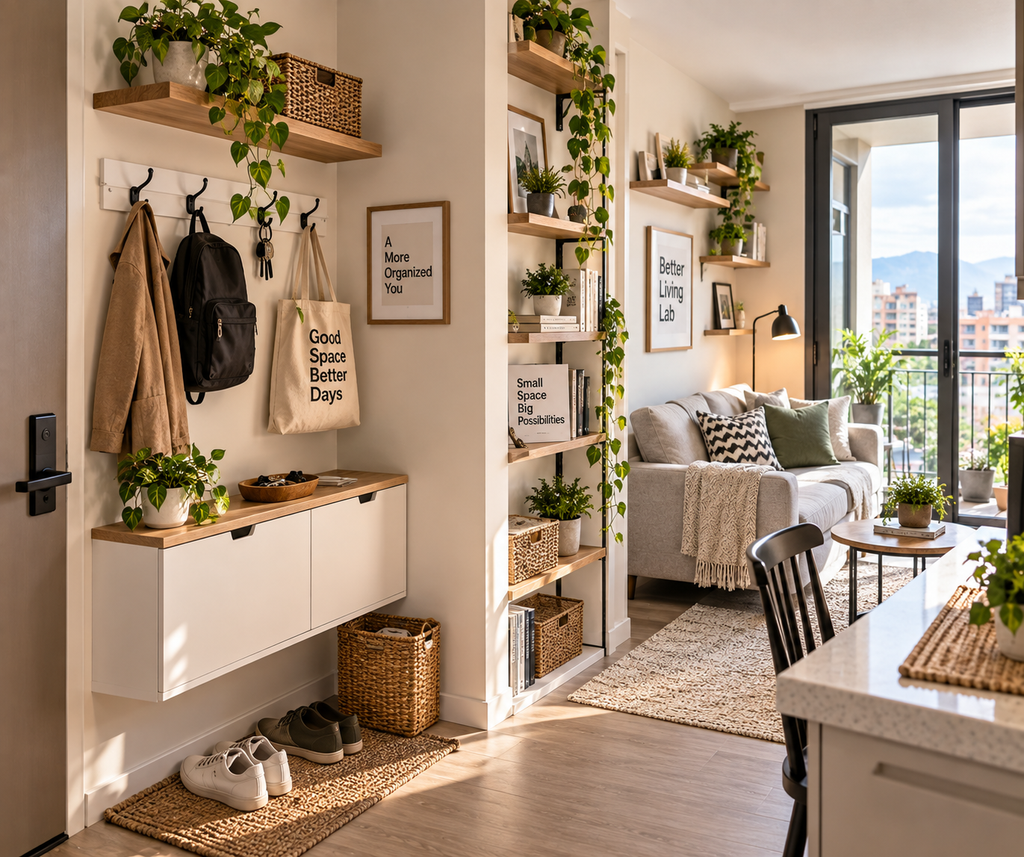
Use vertical storage where it makes sense
Consider adding:
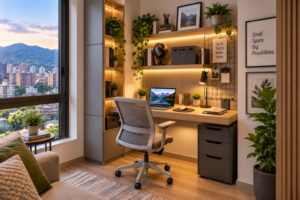
- Floating shelves above a desk
- Shelving above the toilet
- Hooks behind doors
- Tall bookcases instead of wide ones
- Cabinets that extend closer to the ceiling
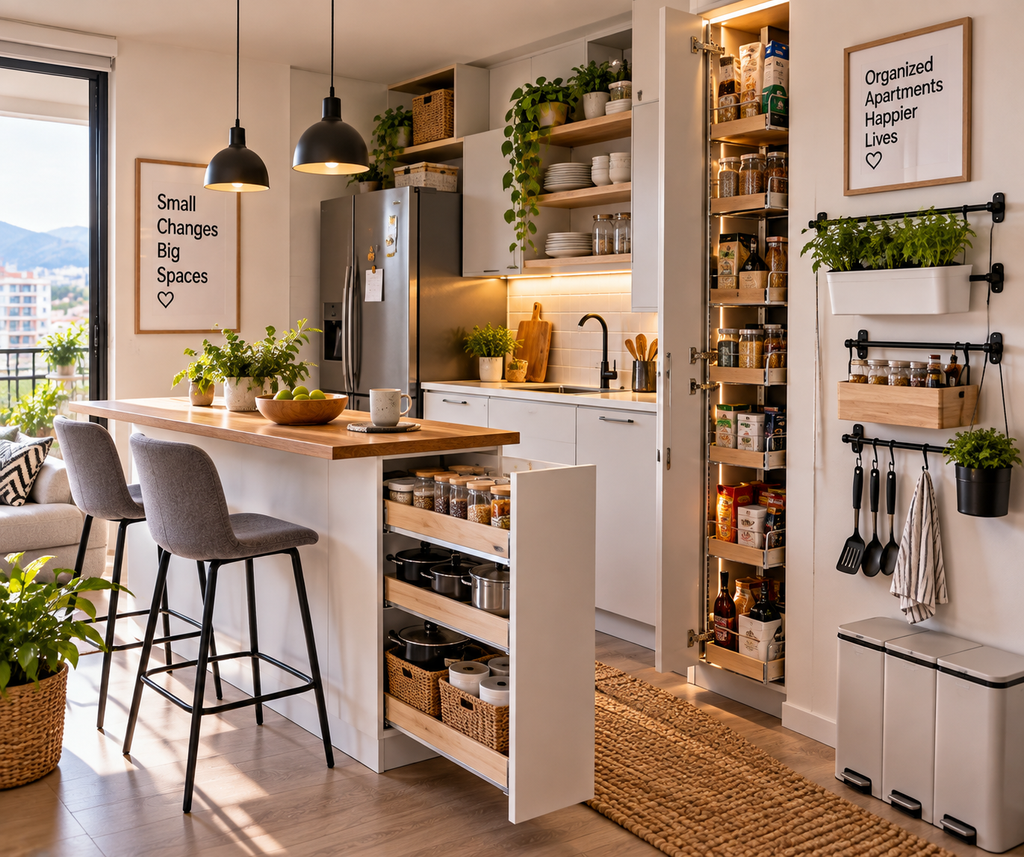
- Wall-mounted organizers in the kitchen
- Pegboards for frequently used items
The goal isn’t to cover every wall with storage. That can make a small room feel visually heavy.
Instead, choose one useful vertical storage area and let the rest of the room breathe.
Make Your Furniture Work Harder
In a small apartment, furniture that performs only one job can take up valuable space.
A bed, bench, coffee table or ottoman can also become storage.
A simple change can eliminate an entire extra cabinet.
For example, a bed with drawers underneath can hold bedding, seasonal clothing or shoes. A storage ottoman can keep blankets and electronics out of sight while still providing seating.
Before buying another organizer, ask:
Can something I already need also provide storage?
That’s usually a better solution than adding another piece of furniture.
At Better Living Lab, we prefer this kind of solution because it doesn’t ask you to sacrifice more floor space. In a small apartment, every new piece of furniture should earn its place. If it can solve two problems instead of one, even better.
Don’t Fill Every Available Space
This sounds strange in an organization article, but empty space is useful.
We’ve all done it: you see an empty corner and immediately start thinking about what could fit there. A shelf? A small cabinet? Another basket? Sometimes the best answer is nothing. If the apartment already works without it, leaving that corner alone can actually make the room feel better.
Not every shelf needs a basket. Not every wall needs hooks. Not every corner needs furniture.
When every available centimeter is occupied, even an organized apartment can feel crowded.
Try leaving some breathing room:
- Keep part of a shelf empty.
- Leave a little space between decorative objects.
- Avoid filling the top of every cabinet.
- Keep major walking paths clear.
- Limit what stays permanently on countertops.
That visual space makes a room feel calmer and often makes the things you actually use easier to find.
Create a Kitchen That Resets Quickly
Small kitchens are especially unforgiving.
Three or four items on a compact countertop can make it look completely full.
Start by deciding what truly deserves permanent countertop space.
Your coffee maker might stay. The appliance you use twice a month probably shouldn’t.
Look inside the cabinets differently
Don’t just organize shelves from left to right.
Look for wasted space above and below what you’re storing.
Shelf risers can create a second level for plates or mugs. Door-mounted organizers can hold small items. Hooks beneath cabinets can free up shelf space.
Even a narrow gap beside the refrigerator may accommodate a slim rolling cart.
The best small kitchen isn’t the one with the most organizers. It’s the one you can return to order in five minutes.
Fix the Closet Before Buying More Storage
When a closet feels full, buying more containers seems like the obvious answer.
Sometimes it’s the wrong one.
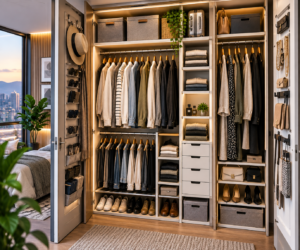
Take everything from one section—not necessarily the whole closet—and divide it into three groups:
Use regularly: keep it easily accessible.
Use occasionally: move it higher or farther back.
Rarely or never use: decide whether it deserves valuable storage space at all.
Then organize what’s left.
This order matters. Otherwise, you may spend money creating an efficient system for storing things you don’t actually need.
Use Hidden Spaces Carefully
Small apartments often contain storage opportunities that are easy to miss.
Look under the bed, behind doors, above existing cabinets and beneath furniture.
But there’s a catch.
Hidden storage can easily become forgotten storage.
If you put something under your bed and don’t see it for two years, that space isn’t helping much.
Use hidden areas for specific categories, not random objects.
For example:
- Under-bed box → winter clothes
- Top closet shelf → luggage
- Storage ottoman → blankets
- Bathroom basket → extra toiletries
- High kitchen cabinet → occasional serving pieces
Labels can also help when containers aren’t transparent.
Organize Around Frequency, Not Appearance
A beautiful storage system can still be frustrating.
If something you use every morning is stored in a difficult-to-reach container because it looks cleaner there, you’ll eventually stop putting it back.
Keep frequently used items within easy reach.
Move occasional items higher, lower or farther away.
Store rarely used possessions in the least convenient areas.
This simple rule can completely change how functional a small apartment feels.
Convenience is part of organization.
Control the Visual Noise
Sometimes a room isn’t physically cluttered, but it still feels cluttered.
Too many visible containers, labels, cables, colors and small objects can create visual noise.
Try grouping similar objects instead of displaying them separately.
For example, five small bathroom products scattered across a counter look busier than the same five products contained in one simple tray.
The same principle works with:
- Remote controls
- Chargers
- Cooking utensils
- Cleaning products
- Office supplies
- Children’s items
You’re not necessarily removing anything. You’re giving the eye fewer separate things to process.
Build a 10-Minute Reset Into Your Day
The most effective organization system is one you can maintain when you’re tired.
If we walked into a small apartment that felt crowded, we wouldn’t start by buying organizers. We’d look for the three places where clutter keeps returning. Maybe it’s the dining table, the kitchen counter and that chair in the bedroom that somehow becomes a second closet.
Those three spots tell us more than a perfectly organized cabinet ever could. Fix the reason things accumulate there first. Add a hook where the bag actually lands, create a tray for the things that collect on the counter, or give tomorrow’s clothes a dedicated place instead of the chair.
Small changes like these aren’t particularly glamorous, but that’s exactly why they tend to work. They solve what actually happens in your home rather than what an organized apartment is supposed to look like.
Set aside ten minutes at the end of the day—or whenever it naturally fits your routine—to reset the apartment.
Put shoes away. Clear the kitchen counter. Return objects to their landing zones. Fold the blanket on the sofa. Take anything that belongs in another room with you as you move through the apartment.
Don’t try to clean the entire home.
You’re simply returning things to the system you’ve already created.
Ten minutes consistently is usually more useful than waiting until the apartment becomes overwhelming and spending half a Saturday fixing it.
Your Apartment Doesn’t Need More Space to Feel Better
Before buying another cabinet, basket or organizer, look at how your apartment currently works.
Notice where clutter starts. Notice which storage spaces are difficult to use. Notice what keeps ending up on chairs, counters and floors.
Then solve those problems one at a time.
A well-organized small apartment isn’t a home where everything is hidden. It’s a home where the things you use have sensible places, the things you don’t need aren’t taking over valuable space, and putting everything back doesn’t require much effort.
Start with the messiest spot in your apartment today. Fix that one area properly before moving to the next. You may be surprised by how much bigger the whole home begins to feel.